In this article
How to Build a Digital Nomad Portfolio That Lands Remote Clients
You have the skills. You have the experience. But clients still hesitate.
It's not because you lack talent. It's because "Digital Nomad" still sounds like "Risky Hire" to conservative businesses. They picture you sipping coconuts on a beach with spotty WiFi, missing deadlines while chasing sunsets.
Your portfolio is the only tool that can kill that bias.
Why Standard Portfolios Fail for Nomads
Most freelancers treat their portfolio like a museum: "Look at this thing I made."
For a digital nomad, that's fatal. You aren't just selling a deliverable; you're selling the assurance that you can deliver it from 5,000 miles away.
The "Vacation" bias is real. If your site screams "travel blog," clients worry about your focus. If it looks like a generic corporate template, they forget you instantly. The magic happens in the middle: showing you have the global perspective of a traveler but the operational discipline of a Navy SEAL.
Standard portfolios show what you did. Nomad portfolios must show how you work.
The 5 Pillars of a High-Trust Portfolio
1. Remote-First Case Studies
Stop listing just the results. List the logistics.
See the difference? You just sold your reliability, not just your design skills.
2. Radical Transparency
Many nomads try to hide their location. They rent virtual offices or pretend to be in Kansas.
Don't do that. Own your mobility.
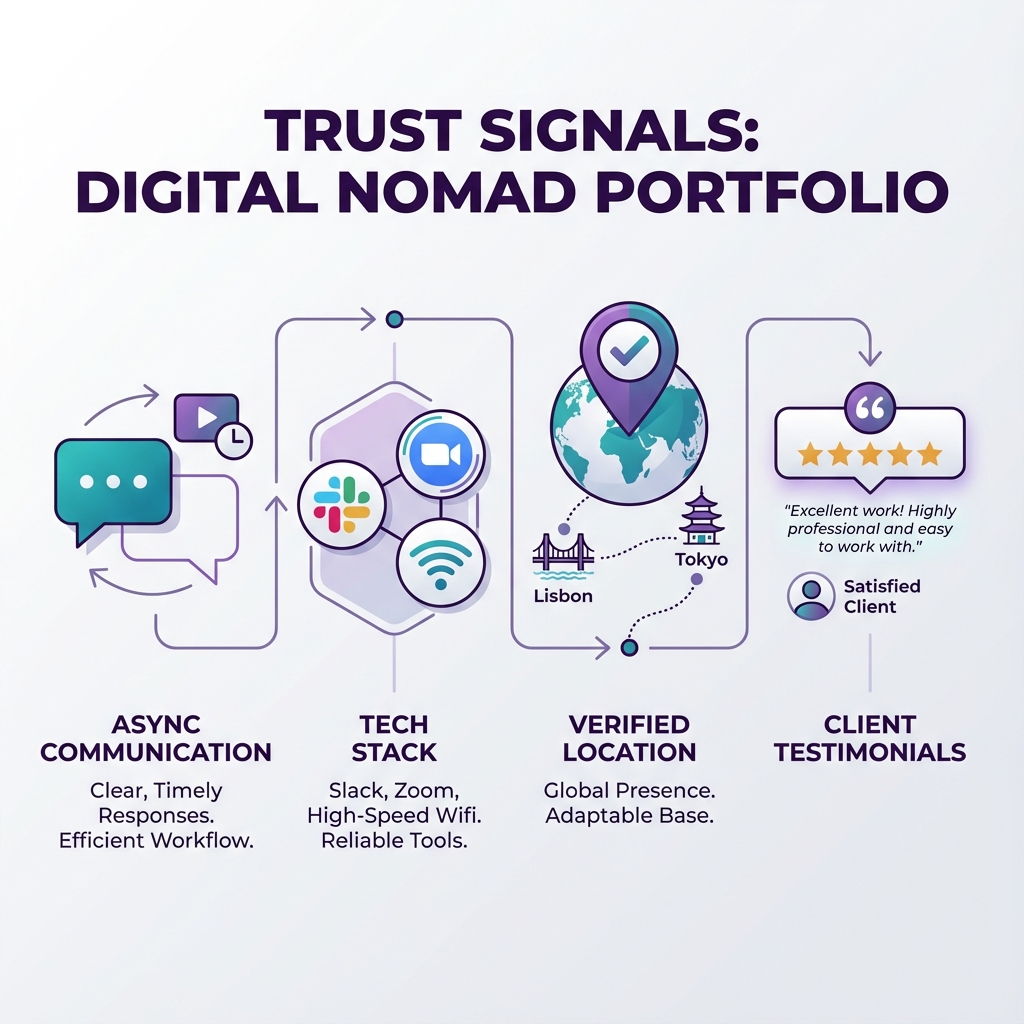
Transparency builds trust. Add a "Current Base" section. "Currently in Tokyo (GMT+9). Overlapping 4 hours with EST mornings." This signals that you manage timezones professionally, not accidentally. It turns a potential objection into a proof of competence.
3. The Tech Stack Showcase
Dedicate a section to your "Remote Office."
It sounds trivial, but listing your tools—Slack, Zoom, Asana, Figma, Starlink—signals pro-level readiness. It tells the client, "I speak your language, and I won't drop off the call because of bad hotel WiFi."
4. Social Proof with a Twist
Testimonials are standard. But you need specific kinds of testimonials.
Hunt for quotes that mention your responsiveness. "Even though Mark was in Bali, he was more responsive than our in-house team." That single sentence is worth more than ten paragraphs of you promising to be reliable.
5. Video Introductions
Video augments trust by 20-30%. It bridges the physical gap.
Embed a simple 60-second Loom video. "Hi, I'm Sarah. I specialize in building SaaS landing pages. Here's a quick look at my async workflow..."
Seeing your face and hearing your voice validates you're a real human professional, not an faceless outsourcer or a bot.
The Good, The Bad, & The Risky
Let's look at three common archetypes we see.
The "Lifestyle Overload" (Bad)
The "Generic Corporate" (Bad)
The "Islander" Balance (Good)
Choosing Your Platform
| Platform | Best For | Nomad Score | Why? |
|---|---|---|---|
| Indie Island | Nomads/Indies | ⭐⭐⭐⭐⭐ | Built-in verification & community trust signals. |
| Carrd | Minimalists | ⭐⭐⭐ | Fast to launch, but can feel "cheap" if not designed well. |
| Webflow | Designers | ⭐⭐⭐⭐ | High control, but high maintenance on the road. |
| Upwork | Beginners | ⭐⭐ | You rent your reputation. High fees, low control. |
Launch Your Trust Engine
You don't need months to build this. You can launch a version 1.0 this weekend.
- Audit: Remove the vacation vibes from your professional pages.
- Record: Shoot that 60-second intro video. Imperfect action beats perfection.
- Build: Set up your Indie Island profile. It's designed specifically for this "trust-first" approach.
- Proof: Rewrite 3 case studies to highlight your async workflow.
Stop chasing clients. Build a portfolio that makes them feel safe hiring you.
- State of Independence Report - MBO Partners
- Remote Work Statistics - Buffer
- Freelance Forward - Upwork
Tags
Stay updated
Get the next drop in your inbox
We only send thoughtful dispatches. Unsubscribe anytime.
Join the list